The West Meade Discount Is Shrinking, and a Fight Over Trees Explains Why
September 3, 2026
September 3, 2026
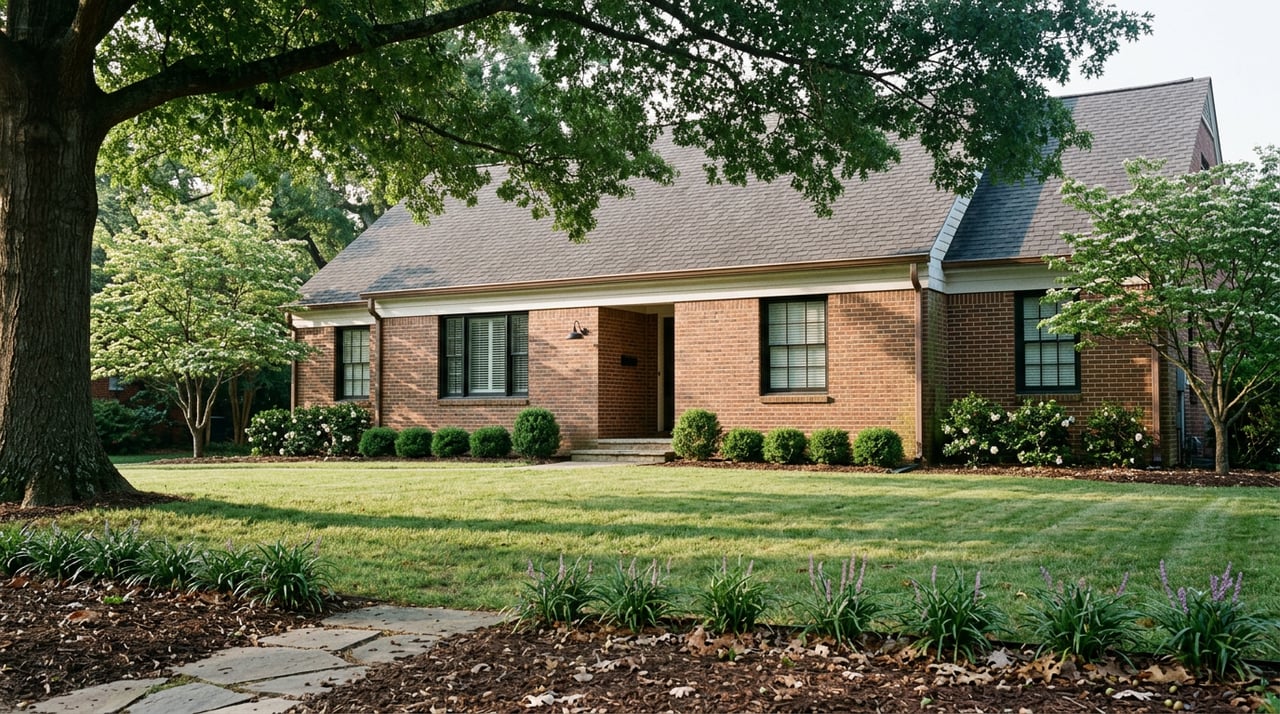
Last year, a homeowner in West Meade watched a crew clear-cut a stand of trees on a neighboring lot before anyone had pulled the right permits. Nashville's NewsChannel5 covered what happened next: a stop-work order landed on the property, but the trees were already down, some of them estimated at 80 to 90 years old, maybe closer to a century. A member of the West Meade Neighborhood Association pointed out that a single mature tree can hold back up to 100 gallons of stormwater a day, the kind of quiet infrastructure work you only notice once it's gone.
If you're comparing West Meade to Belle Meade on a spreadsheet, that incident looks like a footnote. It isn't. It's the leading edge of a story that changes what a "good deal" in West Meade actually means in 2026.
Here's the assumption most relocating buyers walk in with: West Meade sits between Belle Meade and Bellevue, the lots are enormous by Nashville standards, the housing stock is full of mid-century ranches ripe for a rebuild, and the whole neighborhood functions as a discount entry point into old-money West Nashville. Buy the ranch, tear it down or gut it, build something that would cost twice as much two streets over. That math used to be simple. It still works, but the discount is smaller than it looks, and the newest variable in the equation isn't a mortgage rate. It's a zoning fight that's currently being organized street by street.
West Meade's oversized lots aren't an accident of modern zoning. They trace back to 1944, when the children of Justice Howell Edmunds Jackson sold the western portion of the old Belle Meade Plantation to a group of Nashville investors led by E.A. Wortham and Brownlee O. Currey, who incorporated the land under the name West Meade Farms, Inc. The original plan carved up part of the 1,700-acre tract into small farms. Those farms disappeared decades ago, replaced by the wave of post-World War II ranch homes that still make up most of the neighborhood's housing stock today. That history is why so many parcels here run close to an acre or larger. It's also why the "renovate this ranch or build your dream home" listing has become a familiar template on West Meade home pages: the bones of the neighborhood were built for exactly that kind of second act.
Two separate snapshots from spring and early summer 2026 tell a consistent story. In May 2026, active West Meade listings averaged $2,625,510 with an average price of $498 per square foot. By June 2026, the average listing price had settled to $2,251,824 with an average of $453 per square foot. Different sampling windows, same range: West Meade in 2026 is not pricing like a discount neighborhood. It's pricing like Belle Meade's less expensive cousin, not its bargain basement.
For context, Belle Meade's median sale price sits at $2.85 million, up 4.1 percent year over year according to 2026 market reporting. West Meade's average list price isn't far behind that median, and its per-square-foot numbers are climbing toward what Belle Meade commands on comparable new construction. The gap that used to make West Meade the obvious value play has narrowed enough that buyers need to look past the average and into the ladder of actual entry points.
Here's how that ladder breaks down in 2026:
| Entry Point | Typical Price Range | What You're Actually Buying |
|---|---|---|
| Vacant lot, roughly 0.9 to 1.1 acres | $400,000 to $700,000 | Land only, buildability depends on slope, frontage, and current zoning status |
| Mid-century ranch, original condition | $500,000 to $1.2 million | 1950s to 1970s structure, teardown or gut-renovation candidate |
| Renovated ranch or updated home | Roughly $1 million to $2.5 million+ | Turnkey living with character preserved |
| New construction or luxury rebuild | Averaging $2.25M to $2.6M, $453 to $498 per square foot | Ground-up product now competing with entry-level Belle Meade pricing |
A full teardown-to-move-in project in West Meade typically runs 12 to 24 months once you account for demolition, plan review, and construction, which means anyone buying at the bottom of that ladder today is making a bet on what the neighborhood looks like in 2027 or 2028, not just what it looks like now.
That timeline is exactly why the tree canopy fight matters more than it first appears. The West Meade Neighborhood Association is currently sponsoring an Environmental Overlay that could affect more than 700 homes in the neighborhood, an effort framed explicitly around protecting residents from overbuilding. Metro Councilmember Thom Druffel, who represents District 23, has gone further, launching an initiative called Friends of West Meade Hills, modeled on the long-running Friends of Warner Parks, with the stated goal of setting up a strategic land trust to protect the neighborhood's green canopy from what the group calls encroaching development. Druffel has told local reporters that West Meade could be rezoned to allow greater density, and that neighbors have already had some success asking builders to minimize tree removal, though the underlying pressure hasn't gone away.
None of this is settled policy yet. The overlay is still being organized, its exact boundaries and requirements are still being worked out, and the WMNA's own materials tell residents to check whether their specific parcel would be affected rather than assuming a blanket rule. But for a buyer evaluating a ranch-on-an-acre as a rebuild opportunity, "still being organized" is precisely the risk. A teardown project already carries a 12 to 24 month runway. If a tree-preservation overlay adds a review layer, changes the buildable envelope on a wooded lot, or simply slows down permitting while the ordinance works its way through Metro Council, that timeline stretches, and the arithmetic that made the lot attractive in the first place gets less certain.
The broader Nashville market gives this some useful texture. Inventory across Greater Nashville rose through the first half of 2026, and days on market have lengthened into the 50s and 60s according to Greater Nashville REALTORS data, giving buyers more leverage in the entry-level and mid-price tiers. But the segment above roughly $800,000, where most West Meade product now lands, has continued moving at its own pace. That combination matters for how you read a West Meade listing: a slower macro market doesn't mean a slower West Meade market, and it doesn't mean the tree canopy debate is happening in a market that's cooling off enough to make it irrelevant.
If you're a buyer looking at a mid-century ranch marketed as a teardown opportunity, the smart move is to ask direct questions before you write the offer, not after. Is the parcel inside the proposed overlay boundary? Has the seller had any conversations with the neighborhood association or the District 23 council office about pending changes? What does the builder's timeline assume about permitting conditions that might not hold for another 18 months?
If you're a seller holding a large-lot ranch and weighing whether to market it as a renovation candidate or a rebuild site, the overlay conversation cuts both ways. Some builders will pull back from a lot with political uncertainty attached to it. Other buyers, particularly the ones drawn to West Meade specifically for its tree canopy and privacy, will see the same conversation as a reason to trust the neighborhood's long-term character rather than a reason to walk away. How you position the listing, and who you position it to, should reflect which buyer you're actually trying to reach.
Does the proposed overlay affect existing homes, or only new construction and major redevelopment? Based on how the neighborhood association has framed it, the stated intent is to curb overbuilding and clear-cutting on larger or high-slope lots, not to restrict routine maintenance on existing homes. The specifics are still being finalized, so confirm directly with the WMNA or the District 23 council office before assuming either way for a given parcel.
Is West Meade still less expensive than Belle Meade? Yes, on median price. But the gap on a per-square-foot basis for new construction has closed enough that the "discount" argument works better for renovated character homes than for ground-up rebuilds.
How long should I budget for a full teardown and rebuild? Plan on 12 to 24 months from purchase to move-in, and treat that window as a floor rather than a ceiling if the parcel falls anywhere near the proposed overlay boundary.
West Meade still has the ingredients that made it attractive in the first place: mature trees, real acreage, a location minutes from Belle Meade and Percy and Edwin Warner Parks. What's changed is that the trees themselves have become part of the transaction, not just the backdrop. Anyone weighing a move here deserves a clear-eyed read on where the political process stands on a given street, not just what the comparable sales say.
If you're comparing West Meade against Belle Meade, Bellevue, or another Nashville neighborhood and want a straight answer on what a specific lot's rebuild timeline and risk profile actually look like right now, Angela Peach can walk you through it. Request a private consultation to talk through the neighborhood, the property, and the process before you write an offer.
Stay up to date on the latest real estate trends.
September 24, 2026
September 17, 2026

September 10, 2026
September 3, 2026
August 27, 2026
August 20, 2026
August 13, 2026
August 6, 2026
August 6, 2026
Real estate is more than just a process or a transaction; it is a journey and a destination. As a multi-million and top 1% producer in the Greater Nashville area, Angela and her team can seamlessly guide you throughout all your real estate ventures.